

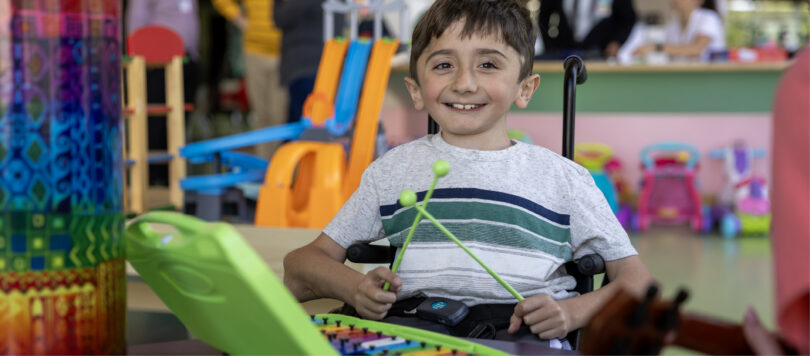
Brittle bone disease, a rare condition seen frequently at Shriners Children’s, is a genetic disorder characterized by frail bones.
But not a fragile spirit.
On the contrary, many of our young patients with the condition are exceptionally sturdy, vibrant and irrepressible.
Dominic is one of those kids — a patient from Shriners Children’s Northern California who tackles life with great fortitude and a generous nature.
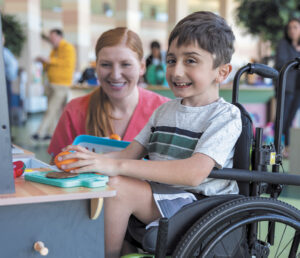
Senior recreational therapist Gwen Hall spends quality time with Dominic at Shriners Children’s Northern California. Dominic and the care team agree — when they work together, they each get a boost.
When Dominic was just 6 weeks old, an X-ray revealed he had broken every bone in his body. This led to his immediate transfer to Shriners Children’s Northern California, where he was diagnosed with osteogenesis imperfecta (OI).
OI is caused by a gene defect that affects collagen production, resulting in bones that may be deformed or break easily, which can lead to spine curvatures.
OI has been described as a chronic condition with crisis periods. Children frequently experience a lot of pain and disruption due to bone breaks. They often miss developmentally important milestones and tend to spend more time with adults rather than other children.
Strength in spirit — and outlook
Dominic’s OI was further complicated by an additional diagnosis of Bruck syndrome, an extremely rare condition that combines bone fragility with congenital joint contractures (where joints are permanently bent or fixed, limiting movement). This dual diagnosis made him one of only a handful of known cases in the U.S. with both conditions.
Dominic uses a wheelchair and requires assistance with simple tasks. Yet his spirit is indomitable.
Dominic’s care has been led by a specialized team at Shriners Children’s Northern California headed by Joel Lerman, M.D., and Rolando Roberto, M.D., chief of staff and medical director of the pediatric spine program. Dominic has undergone numerous surgeries, including fracture repairs and spinal procedures. When he was 6 years old, he sustained a spine and neck injury that required a halo device for stabilization.
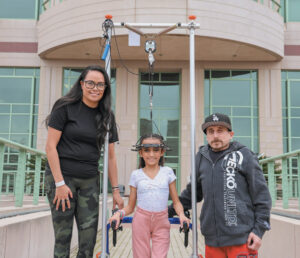
Anakalia and her parents, Krystine and Mike, value the expertise and high level of care provided by Rolando Roberto, M.D.
For Dominic and his family, the hospital has become a second home. During extended stays, he enjoys music therapy and looks forward to visits from therapy dogs. The staff goes above and beyond to make him feel special, even remembering his dislike for soup.
Dominic’s charisma has made him a beacon of hope for other patients. He often encourages children before their surgeries and worked with the hospital’s marketing team to create a donor video during the pandemic. Dominic’s dream is to have his own YouTube channel, and he’s brainstorming ideas for a special teddy bear to comfort kids in the hospital.
“It’s crazy to think of everything he’s been through in 10 years,” his mother, Lucy, said. Supported by his parents and two older sisters, Dominic continues to inspire everyone he meets, proving that even in the face of immense challenges, there is always hope.
“Dominic comes in surrounded by family — always,” observes Dr. Roberto. “I firmly believe that gives him the reserves to inspire so many others.”
A lovely young influencer
Another patient at Shriners Children’s Northern California, 14-year-old Anakalia, is not letting OI hold her back. She has a bold spirit that fills any room she is in.
Anakalia has an Instagram page that has attracted 40,000 followers. Not bad for someone who has only been posting for a year. In her posts, Anakalia dispenses makeup advice and dances in the hospital — and her spoof of a macaroni and cheese commercial has gone viral. But importantly, she also shares her medical journey and has become an educator and voice for others with brittle bone disease.
Anakalia has OI Type III, which is generally characterized by a shorter stature, bone deformities and fractures present at birth. Painful fractures have been a frequent part of Anakalia’s life. Four years ago, a Shriners Children’s surgical team placed rods in her legs to provide strength and stability.
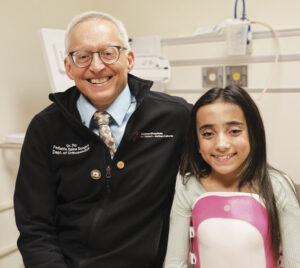
Known to patients and families as “Dr. Ro,” Dr. Roberto is a spine specialist at Shriners Children’s Northern California.
“I haven’t broken a bone in my legs since I got the surgery,” she said, always looking on the bright side.
Due to her OI, Anakalia’s spine had a curve. Last year, she spent four weeks in halo traction — a process that straightens the spine in preparation for a spinal fusion. True to form, after an initial adjustment to the halo, she decorated her room and filmed herself dancing in her traction walker.
“I was looking forward to this,” Anakalia said. “I was excited to straighten out and be taller.”
The results of her surgery were excellent. While her family hoped only to stop the curve from progressing, her physician, Dr. Roberto, achieved far more: Anakalia went from a curvature of almost 90 degrees to 34 degrees.
Anakalia’s mom, Krystine, is amazed by her daughter’s spirit. “I’m so proud of her and the strength she has shown throughout this journey,” she said. “We’ve never allowed her osteogenesis imperfecta to define her or limit what she’s capable of.”
OI research targets in utero bone strength
Research is a critical part of Shriners Children’s mission to advance care in the conditions we treat, including OI. That commitment makes OI research and the pursuit of improved treatments part of our work.
Arin Oestreich, Ph.D., of Shriners Children’s St. Louis, has long studied ways to strengthen OI bones before birth, potentially with lasting effects. Recently, Dr. Oestreich and colleagues from nearby universities received a $3.1 million National Institutes of Health grant to support this work for five years.
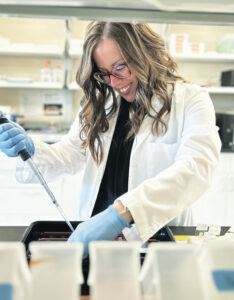
Dr. Arin Oestreich’s early work has shown promise to minimize some of the worst effects of OI.
The research is focused on a protein called myostatin, which regulates muscle and bone growth. The hope is that lowering the levels of myostatin during development might result in stronger muscles and bones.
“We’re looking at the uterine environment and how it can influence long-term bone strength,” Oestreich explained. “Our goal is to use what we learn to strengthen OI bones from the very beginning of development.”
The research team has previously shown that low myostatin levels in mouse mothers produced pups with stronger bones, even in those with OI. Next, the team will examine the safety of reducing myostatin with antibodies in normal mouse mothers.
“This strategy will not cure OI, but we’re hopeful that we can maximize muscle and bone strength in order to prevent fractures throughout the lifespan, and that’s what this grant is all about.”
Research at Shriners Children’s is uncovering new ways to strengthen bones and prevent fractures in children with OI. For kids like Anakalia and Dominic, this can mean a future filled with more freedom, fewer setbacks and greater chances to thrive.


