


Deep under the sea, 9-year-old Levi explores coral reefs, a sea turtle and even a shark. Levi can enjoy this adventure from the comfort of his hospital bed at Shriners Children’s Ohio thanks to virtual reality (VR) technology. It’s another tool Shriners Children’s child life specialists use to help children cope with procedures related to their burn injuries.
“Some children don’t want to watch during a dressing change or procedure, so slipping on the virtual reality goggles makes a big difference,” child life specialist Kim Flood said. “VR not only blocks the sights of what’s happening at the bedside but transports kids to a fun, engaging universe.”
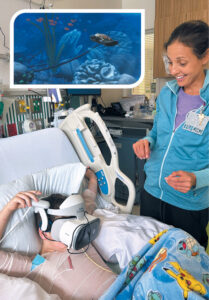
To help him manage pain, Levi, 9, engages with ocean life via a virtual reality headset.
For Levi, it’s about escaping to a different world. As soon as Kim places the headset, he exclaims, “Whoa! A shark!”
Child life specialist Michelle Smith said this technology allows kids to immerse themselves in a variety of experiences — from nature scenes to interactive activities.
“I like seeing the different animals under the water and how I can reach out and touch them,” Levi added.
Escaping into virtual worlds reduces anxiety for many kids like Levi, but this technology isn’t a good fit for every patient or procedure.
“We find VR works best with school-aged children,” Michelle explained. “But not every patient can tolerate a long-term immersive experience during more painful or anxiety-inducing procedures.”
Some of the most common uses for VR are relaxation for patients who fixate on pain or itching, to teach coping skills like breathing or visualization, or to promote movement. But the child life team stresses that VR technology is just one of many tools. Every child copes differently, so the team is trained to assess their patient’s unique needs and understand how they best process stressful situations.
“Our goal is to help children feel less anxious and more in control, so we’re always exploring new techniques or technology that can help us do just that,” Michelle said.


