

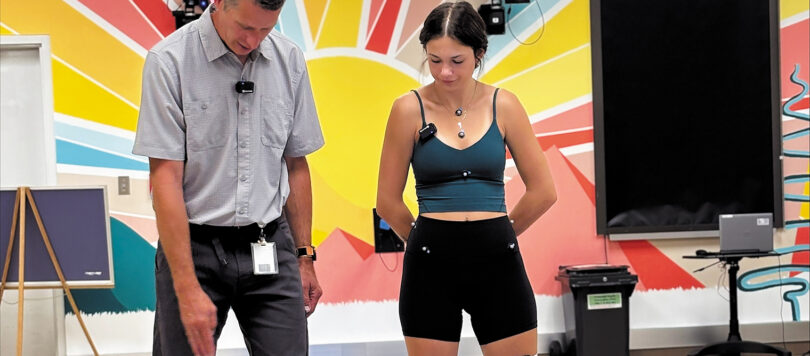
Returning to activity too soon after an injury is one of the biggest risk factors for reinjury. Shriners Children’s Spokane’s structured Return to Sport Protocol ensures that young athletes fully recover before they safely return to play, protecting their long-term health.
Patients receive care from a multidisciplinary team within the Sports Health and Medicine program, including sports medicine physicians, physical therapists, athletic trainers, and strength and conditioning specialists.
Clinicians are seeing ACL injuries more often in young athletes, particularly in sports that involve jumping, cutting and quick direction changes, such as soccer, basketball and football. The protocol addresses both the physical and psychological aspects of recovery. “Our goal isn’t just return to play — we use evidence-based programs and proven protocols to ensure patients are strong enough to return with confidence,” said sports medicine physical therapist Kelly Bartleson, MPT, OCS, CMPT.
Following the data
The team uses advanced technology in the Motion Analysis Center (MAC) and detailed movement data to guide recovery. Special cameras track markers placed on the body while force plates measure how much pressure joints experience. This shows how the body moves in three dimensions and whether joints are under unusual stress — details the naked eye cannot detect.
“These studies provide precise, objective data that helps tailor treatment and ensure patients are ready to return to the demands of their sport,” explained physical therapist Kris Holden.
Performance checks for safe recovery
MAC specialists use six performance tests to observe kinematic movement patterns and capture biomechanics data on our ACL reconstruction patients.
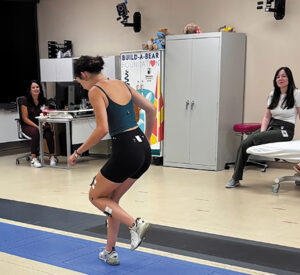
Lainee’s mom, nurse executive Missy Martin, watches her progress.
- Drop Jump Vertical: Assesses landing mechanics and knee stability from jumping from an 18-inch box onto two separate force plates simultaneously then jumping back up.
- Y-Cut: Running forward and cutting left or right at 45 degrees on force plates to simulate a change in direction evaluates stability, motion and shock absorption.
- Deceleration: Moving forward and backward on a force plate simulates a change in deceleration to provide data on stability and the amount of motion that is occurring.
- Lateral Shuffle: Checks for hip and core control when performing side-to-side movements on a force plate.
- Single Leg Squat: Performing a heel touch on the ground off an 8- to 12-inch box helps find where the center of mass lines up.
- Single Leg Hop: Hopping onto a force plate for distance with a single leg and holding the landing for 3 seconds measures power and stability.
While ACL injuries are one of the most studied, the same principles apply to all sports injuries. Return to sport evaluation is a complex process tailored to the needs of the individual, their injury and the patient’s chosen sport.


