

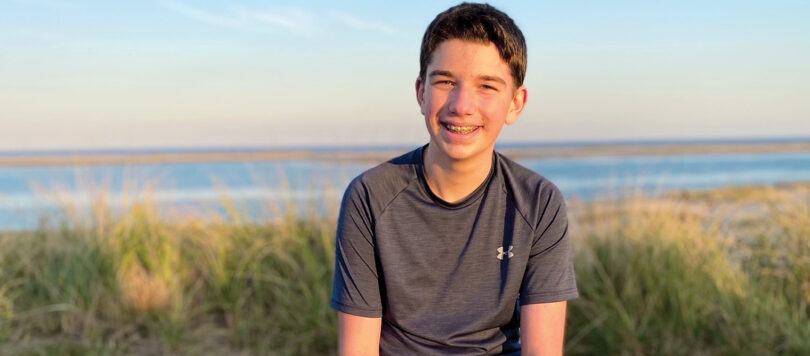
Summer brings freedom and fun for families — beach days, barbecues, fireworks and long hours outside. It’s also a season when preventable injuries spike. The specialists at Shriners Children’s have a simple message: With the right precautions, summer can stay safe and memorable.
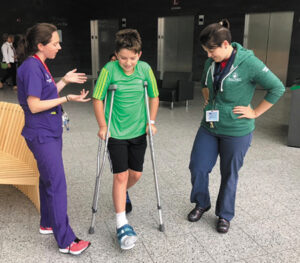
Sawyer had months of physical therapy following his burn injuries.
Burn dangers lie beneath the surface
Many families believe that once their campfire or fire pit has been extinguished, the area is safe. In reality, ashes and embers can retain heat for hours, creating a significant burn risk.
While flames may be gone, hot coals can remain. “Don’t think ‘out of sight, out of mind’ when covering up a beach fire with sand,” said Melissa DiPiro, MSN, RN, CPNP-PC/AC, nurse practitioner at Shriners Children’s Boston. “It actually makes the coals hotter. To make it safe, use water to cool the area completely.”
At a family celebration on the beach, Sawyer severely burned his feet near a fire pit. Adults at the gathering supervised and extinguished the fire, but after the fire was out, Sawyer walked over the sand where the fire pit had been.
Sawyer required specialized burn care at Shriners Children’s Boston, and his experience underscores an important lesson: Sand traps heat — always pour cold water on the area after using a fire pit.
Summer falls, broken bones
Summer means fun outside on bikes and scooters, at playgrounds and camps. At Shriners Children’s New England, orthopedic surgeon and Medical Director Lael Luedtke, M.D., sees more fractures in the summer, particularly injuries to the wrist, elbow, ankle and collarbone. “When kids aren’t in school all day, they’re moving more, and that naturally increases the risk of falls and injuries,” she explained.
Dr. Luedtke emphasizes that many fractures can be prevented with simple safety measures and supervision. “Helmets, wrist guards and knee pads significantly reduce both the frequency and severity of injuries,” she said.
Not every injury requires medical care, but don’t ignore visible deformity, significant swelling or pain that doesn’t improve within a day or two — these may signal a fracture. Refusal to use a limb or bear weight are also red flags.
Dr. Luedtke encourages families to focus on long-term health rather than short-term setbacks. “That next game, competition or vacation may feel important in the moment,” she said, “but protecting a child’s health for the next 60 years matters far more.”
When fireworks go wrong
David Westberry, M.D., saw how devastating the unsupervised use of fireworks can be early in his career at Shriners Children’s Greenville.
“A young boy lost his hand after a blast,” he said. “It is critical that parents caution their children that not only can fireworks cause painful burns — they can also result in catastrophic injuries to the fingers, hands, arms and other parts of the body and leave lasting challenges with function.”
Sometimes kids will bundle fireworks together hoping for an even more impressive show, but that multiplies the potential for devastating consequences, Dr. Westberry notes.
To keep a celebration from turning into a tragedy, follow Dr. Westberry’s straightforward advice. “The very best way to avoid injury to a child is for the firework to never be placed in their hands to begin with.”
Summer should be a season of memories, not emergency visits. With close supervision and smart precautions, families can dramatically reduce the risk of serious injuries and keep the focus on fun.


