

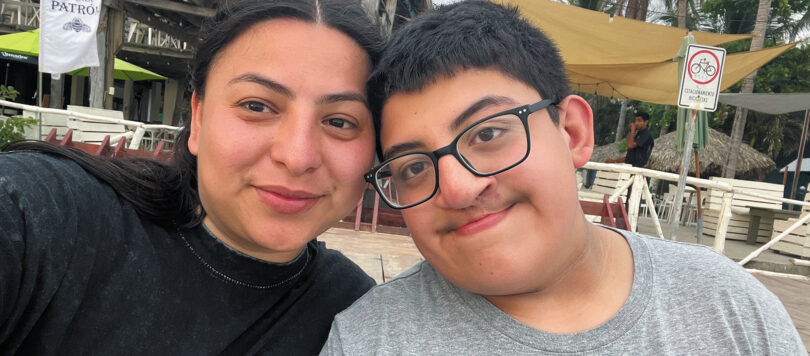
Adolescence can be one of the most complicated phases of cleft care. Surgeries may carry greater impact — not only medically but socially — affecting school schedules, activities and a teen’s growing sense of independence. Permanent teeth emerge. Voices change. Confidence becomes just as important as clinical outcomes.
“Families sometimes feel like they’re ‘done’ after early surgeries, but that’s not the case,” said Rachel Hogan, MA, CCC-SLP, speech-language pathologist and cleft team clinical coordinator at Shriners Children’s Texas. “Cleft care really evolves as kids grow — and no two journeys are the same, especially in the tween and teen years.”
For the past eight years, Hogan has supported patients from infancy through skeletal maturity, helping families anticipate what comes next and understand why timing matters.
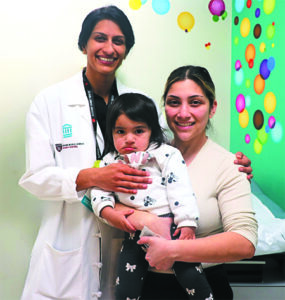
Eliza has been a patient of Dr. Ranganathan’s since shortly after she was born.
Across the Shriners Children’s system, cleft lip and palate care is designed to evolve alongside each child, addressing medical, developmental and emotional needs at every stage.
“As children grow, new treatment phases emerge,” said Kavitha L. Ranganathan, M.D., co-director of Shriners Children’s Boston’s Cleft and Craniofacial Center. “Our team works closely together to time each step appropriately, always keeping the child’s overall well-being in mind.”
For many patients, that includes an alveolar bone graft between ages 7 and 10 to create a stable foundation for permanent teeth.
Timing is everything
Once permanent teeth emerge, orthodontic preparation becomes essential. Oral hygiene — especially for teens with braces — can directly affect surgical timelines. Poor dental care may delay procedures, so teams need to coordinate orthodontic and surgical steps carefully.
“I work closely with the orthodontist, dentist, oral and maxillofacial surgeon and the family to prepare for procedures and time treatment appropriately,” Hogan said.
It’s common for scheduling to revolve around school and family routines. “We see older children later in the day so they can attend school before visiting Shriners Children’s,” Dr. Ranganathan said.
As tweens and teens mature, orthodontics often becomes central, supporting tooth alignment and jaw growth. Additional procedures may include bone grafting, pharyngeal flap surgery to improve airflow during speech and later jaw surgery to improve bite and facial balance.
“Our team can care for health and well-being beyond surgical restoration of the face,” offered Dr. Ranganathan.
When speech and confidence intersect
Adolescence can shift how a child’s speech sounds. Growth affects how sound travels through the nose and mouth, sometimes altering speech that had been stable for years.
As Hogan explained, “Kids may have sounded great for years, and then when they hit adolescence, their speech can suddenly sound more nasal because that tissue was acting like a support.”
Rachel Hogan, MA, CCC-SLP
These changes are monitored closely as patients near the end of their growth, but outcomes are measured in more than clinical terms.
“If a patient is happy and well adjusted, we may wait on surgical intervention,” Hogan said. “But if there are reports of teasing or fear of speaking up in school, we consider intervening sooner.”
Shriners Children’s uses tools such as the CLEFT-Q — a validated, patient-reported outcome measure — to help the team understand how teens perceive their appearance and well-being. Those insights shape decisions based not only on anatomy but lived experience.
Fueling growth and recovery
Treatment phases often require temporary dietary adjustments. At Shriners Children’s Boston, registered dietitian Jenny Shiel, MS, RD, LDN, monitors growth and nutritional intake while coordinating closely with the cleft team.
For older children preparing for bone grafting or jaw procedures, that may include guidance on meal preparation and oral supplements. Shiel recalls working with Evan, a teenager who created a cookbook of practical blender-based recipes drawn from his experience.
“It was so nice to work with Evan and get his input,” she said. “He shared recipes he had actually tried, which made it relatable for other kids going through the same experience.”
Nutrition, like speech and orthodontics, is integrated into the broader, carefully sequenced plan of care.
Supporting families along the way
At Shriners Children’s Texas, Hogan helps teens prepare to manage their own healthcare as they approach adulthood.
“Part of my role is helping connect them with adult providers and resources, so they’re supported even after they age out of our care,” she said.
In Boston, the Craniofacial Patient and Family Advisory Council, launched in 2025, helps families connect with others at different stages of the cleft journey to shape future programming.
“This program is unique to our hospital because we identify what patients and families need — and then we do it,” says care manager Sandy Barrett, BSN, RN, CCM.
A systemwide commitment
Across Shriners Children’s, cleft care is collaborative, carefully timed and designed to evolve with the child.
From early feeding support to speech refinement, orthodontic coordination, nutrition guidance and psychosocial care, teams work together to ensure patients move forward with strong communication skills and confidence.
“We hope they leave us happy, healthy and engaged — whether that’s college, a trade program or simply confident moving forward,” Hogan said.


