

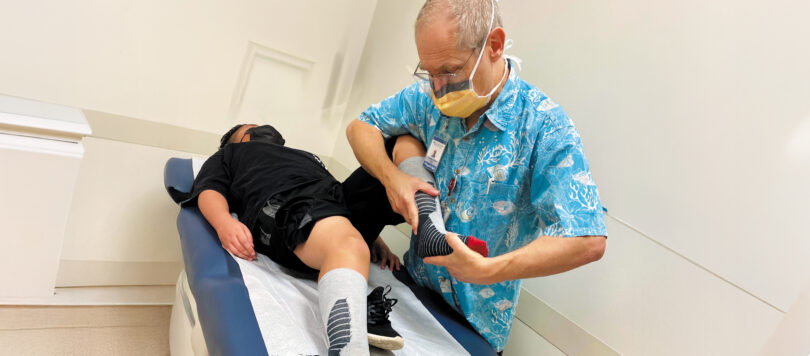
The Pacific Basin has some of the more remote and medically underserved places in the world. Thanks to Shriners Children’s, families in distant communities, from South Pacific islands to the interior of Alaska, have access to world-class pediatric orthopedic care.
For over 20 years, medical teams from Shriners Children’s Hawaiʻi have made annual and semi-annual outreach trips to Guam, Saipan and many South Pacific islands, including Fiji, Tonga and American Samoa, providing the same specialized care offered at the Honolulu hospital.
“These communities are extremely vulnerable. Without this outreach, children in these areas would likely not receive orthopedic care and could end up with complications that could not be fixed,” said Andrew Graul, corporate administrator at Shriners Children’s Hawaiʻi.
At the other end of the Pacific, clinicians from Shriners Children’s Spokane have traveled to Fairbanks, Alaska, typically every other month, since 2018, examining and treating roughly 50 children each visit.
“These communities are extremely vulnerable. Without this outreach, children in these areas would likely not receive orthopedic care and could end up with complications that could not be fixed.”
— Andrew Graul, administrator, Shriners Children’s Hawai‘i
Even when adult orthopedists are available, they can’t provide the specialized care provided by Shriners Children’s specialists. Pediatric orthopedists — unlike adult orthopedists — treat conditions rarely seen in adults, like clubfoot and scoliosis. These specialists are rare, representing about 10% of U.S. orthopedists. In the South Pacific, outside Hawaiʻi, New Zealand, Australia and the Philippines, pediatric orthopedists are essentially nonexistent, according to Graul.
“We see everything from scoliosis, deformity of the legs and arms, and congenital differences to everyday fractures, sprains and tendinitis,” said Jennifer Weiss, M.D., chief of staff at Shriners Children’s Hawaiʻi.
Building trust across the miles
Because clinicians return to each of the 12 different islands they visit, they establish relationships with families — sometimes deep ones.
“We follow patients over time,” Dr. Weiss said. “Some have been coming to us for many years. It is beautiful to witness the relationships between these families and our outreach team.”
While most Shriners Children’s locations have outreach clinics, Hawaiʻi’s program is one of the most extensive in the network, with a cultural element that might not be obvious to someone from the outside, said Graul.
“In the Pacific, there is a cultural understanding across the region that the islands are connected, which gives the outreach broader significance,” said Graul. “The water is not considered a separation, but rather the connection, between all of us.”
Fairbanks serves a wide area
While the Hawaiʻi outreach clinics are staffed by physicians and clinicians, the Fairbanks clinic is managed primarily by Bryan Tompkins, M.D., an orthopedic surgeon at Shriners Children’s Spokane, who emphasizes that the impact goes beyond the one- or two-day clinics.
“These clinics aren’t just about seeing patients,” Dr. Tompkins said. “We also train local doctors and provide education to help communities care for children with complex orthopedic needs.” He’s even presented at medical conferences at the Fort Wainwright U.S. Army base in Fairbanks.
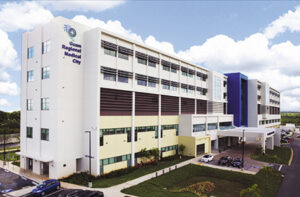
The Shriners Children’s team that travels to Guam holds clinics twice a year at Guam Regional Medical City, in Dededo.
Unlike the Pacific Islands, Alaska has a pediatric orthopedist — just one, based in Anchorage, in the south, which is why the Spokane team travels to Fairbanks, roughly an eight-hour drive from Anchorage. Some of the patients come from even farther north.
“We aren’t just seeing kids in Fairbanks, we’re seeing kids from small rural towns that can sometimes only be accessed via snowmobile, small planes or snowcat,” said nurse executive Missy Martin, MBA, BSN, RN.
Expanding access to high-quality care
Outreach clinics across the Pacific Basin allow Shriners Children’s to bring specialized pediatric orthopedic care to children where they live, rather than requiring families to travel long distances. While some children are eventually brought to Spokane or Honolulu for complex surgeries, many benefit from care close to home.
Both missions have grown over the years. Hawaiʻi has increased visits to Fiji to make up for appointments missed during COVID-19 lockdowns, and Alaska has seen a 50% increase in children served since 2021.
“Outreach clinics also allow us to have a connection to the community by more closely interacting with local pediatric providers,” Dr. Tompkins says. “This outreach embodies Shriners Children’s mission to take care of children in need of our specialized care regardless of their ability to pay,” added Graul.


