

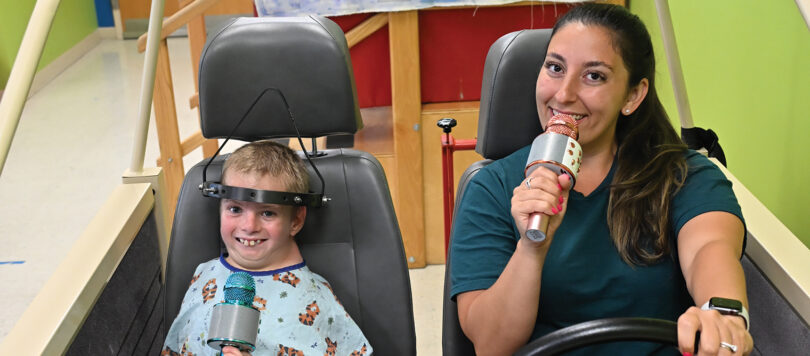
Picture this: 18-year-old Lyneth sits in the back seat of a hospital transfer car, singing “Shallow” from A Star Is Born while music therapist Rebecca “Becky” Dadi, MT-BC, joins in from the front seat. For a moment, it looks like two friends sharing a favorite song. But Lyneth is actually a patient preparing for spinal fusion surgery and undergoing halo traction.
For Lyneth, music became more than entertainment. It gave her an outlet to express herself creatively while coping with anxiety about surgery, delayed studies and being away from home. Becky also invited her to help lead sessions for other patients, giving her a sense of purpose and responsibility during an extended hospitalization.
Moments like this are at the heart of Carpool Karaoke Remixed, an innovative music therapy program at Shriners Children’s Philadelphia that combines creativity, connection and clinical care. Most episodes are recorded and shared on the hospital’s social channels, giving patients a chance to “guest star” in an episode.
Music therapists at Shriners Children’s will tell you the impact of music is more than meaningful for their patients — it’s measurable. It can ease pain, slow heart rate and reduce anxiety.
But just as important, it sparks something else: joy.
In the hands of Shriners Children’s music therapists, music becomes a powerful blend of creativity, comfort and healing, turning clinical benefit into moments of real, unmistakable fun for the kids.
Viral idea, therapeutic purpose
Carpool Karaoke Remixed has become a social media phenomenon, captivating patients and staff alike. This unique, dynamic program uses music therapy to build connection, deepen understanding of medical conditions and treatments and help make the hospital environment feel more approachable.
What started a few years ago as a series to introduce hospital staff to new patients has grown into a larger project. Becky was inspired by the viral segment on James Corden’s The Late Late Show, where he sings karaoke with celebrities in his car. She adapted the idea as an engaging outlet for patients and staff.
Not just any used car
The defining setting for Carpool Karaoke is, of course, a car. When she was first planning the series, Becky was inspired to repurpose the car in the hospital’s physical therapy gym, normally used by patients in wheelchairs to practice getting in and out independently. The transfer car became an inventive new tool for music therapy.
Guest stars choose their own talents to showcase, from singing and dancing to playing instruments and performing gymnastics. With more than 132,000 views across social media platforms, Carpool Karaoke Remixed has become extremely popular, with patients often vying for a spot on the next “episode.”
Fun with a purpose
While Carpool Karaoke Remixed may seem like just a fun series, it is a valuable tool Becky uses to help patients reach their clinical and therapeutic goals.
-Becky Dadi, music therapist, Shriners Children’s Philadelphia
“My main goals are to normalize the hospital environment, reduce anxiety and promote creative expression and self-esteem,” Becky said. “Take halo gravity traction, which can look very scary for kids who may need to undergo that procedure. When future halo patients see other children already in halos on Carpool Karaoke having a great time, it alleviates stress and helps them feel better.”
Eighteen-year-old Gerald experienced that firsthand. While preparing for scoliosis surgery, he worked with Becky to write an original song and perform it on Carpool Karaoke Remixed. Through songwriting, he built self-confidence and processed the emotions surrounding his treatment. In his song, he shared that his differences are what make him special and strong.
Another patient, Sarah, used the platform to speak about adapting to a right leg and foot amputation. She came on Carpool Karaoke Remixed and shared how she is learning to drive with her left foot. “I hope her story will inspire all our patients to follow their dreams and achieve their goals no matter what,” Becky said.
Another episode featured inpatient Ryan as the guest star, with cameos from fellow patients cheering him on and offering high-fives after his performance. The episode captured something that cannot be measured in views alone: the sense of community built within the hospital.
Carpool Karaoke Remixed is more than a social media sensation. It is a creative extension of music therapy that helps reduce anxiety, build confidence and showcase resilience — all while giving patients and staff their moment in the spotlight.
The Power of Song
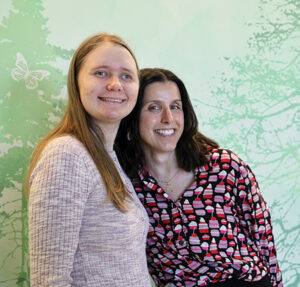
After 15-year-old Vanessa sustained a traumatic brain injury that left her paralyzed and unable to speak, the clinicians who first treated her saw little hope for improvement. But everything changed when Vanessa became a patient of the inpatient rehabilitation program at Shriners Children’s Northern California, where music opened a door into her world. One day, Ronni Paine, MT-BC, NMT, neurologic music therapist, noticed Vanessa responded to songs. Starting with singing a single word, Vanessa progressed to singing entire choruses. From that point on, music was part of her therapy routine. After six months of hard work and dedication, Vanessa walked out of the hospital unaided. She continues to sing and dance, a testament to the power of music therapy.
From Therapy to Daily Practice
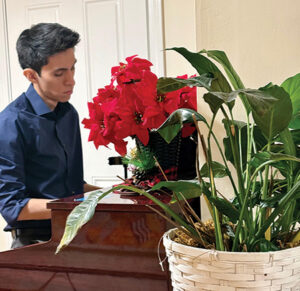
The first time Thomas heard a guitar and a piano being played live was when music therapists visited his room at Shriners Children’s Boston. Thomas, then 9, was being treated for an esophageal burn. “During hospital stays, many people, including myself, need a distraction. Music therapy helped a lot,” Thomas recalled. Nearly 10 years later, Thomas still finds joy in the same passion that was a bright spot during recovery. “Music therapy is one of the reasons I became a pianist — to help others through music.” Thomas is self-taught and enjoys starting his days by playing the piano.
Composition and Connection
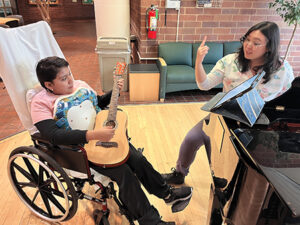
Music therapist Michelle Russell, MT-BC, LPMT, NMT, from Shriners Children’s Chicago, brings her guitar to Marian in the patient activity mall as the two collaborate on a song. Marian, 18, is in the hospital recovering from spine surgery and first connected with music therapy while in halo gravity traction for scoliosis. The therapy helped shift her perspective about feeling like she had limited movement to regaining a sense of control and social connection. Now, during recovery, Marian continues to play the guitar in her hospital room, practicing independently and extending therapy benefits beyond her sessions with Michelle.


