

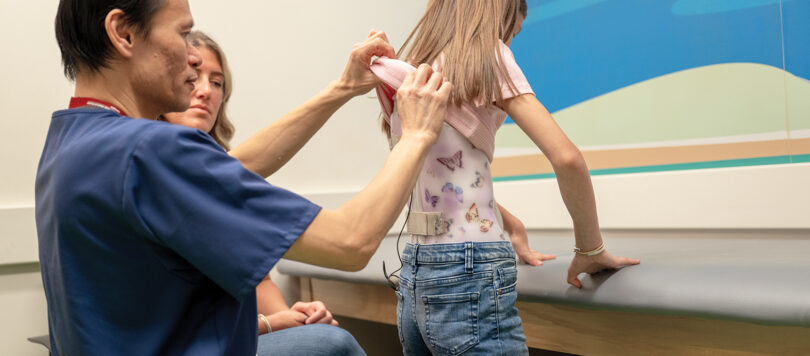
When Shriners Children’s Hawaiʻi patient Stayzia learned that bracing couldn’t correct her scoliosis, she prepared herself for traditional spinal fusion surgery. Then 12, Stayzia understood this would mean giving up significant flexibility in her spine — a sacrifice that felt especially difficult for this competitive volleyball player. But when she met her surgeon, Kyle Mitsunaga, M.D., in 2024, he offered unexpected news: Stayzia was a candidate for a less-invasive surgical procedure called ApiFix.
The choice was clear. Rather than permanently fusing portions of her spine, Stayzia could receive an adjustable implant that would help straighten her curve while preserving the mobility she needed on the volleyball court. She chose ApiFix, joining a growing number of young patients whose scoliosis treatment looks dramatically different than what previous generations experienced.
The ApiFix fix
ApiFix is a major advancement in scoliosis care, offering a less invasive alternative to traditional spinal fusion surgery. Scott Luhmann, M.D., and Brian Kelly, M.D., at Shriners Children’s St. Louis, are among approximately 70 surgeons in the United States trained to use ApiFix technology. The device is anchored onto the spine with a self-adjusting rod, and the surgeon straightens the curve as much as possible in the surgery itself. Then, the device can self-adjust and gradually correct the spine’s curve over time while preserving natural movement and growth potential.
“While traditional spinal fusion surgery and vertebral body tethering (VBT) are both options that we use in some cases, I wanted to bring ApiFix to Shriners Children’s St. Louis so we could provide an alternative treatment with good long-term outcomes,” explained Dr. Luhmann. “The goal is to keep a greater range of back motion and function into adulthood, with fewer additional surgeries.”
The difference is dramatic. The procedure typically requires a smaller incision, and recovery times are much shorter, with patients usually in the hospital only one night and able to resume regular activities within weeks and full activities in as little as three months.
The treatment works best for young teens with moderate-sized spinal curves (up to 60 degrees) who still have growth remaining and a flexible curve. Two to three years after spinal growth is complete, the ApiFix device can be removed through a simple outpatient surgery.
VBT: Trading rods for ropes
For younger patients with significant remaining growth potential, VBT is an excellent care choice that is another departure from traditional scoliosis treatment. Unlike spinal fusion surgery and ApiFix, which are performed through an incision on the back, tethering works from the front of the spine to preserve mobility.
“For the past 50 years, the standard of care for scoliosis treatment has been spinal fusion,” said Amer Samdani, M.D., chief of staff at Shriners Children’s Philadelphia, who has been instrumental in the development and FDA approval of VBT. “The downside is, with those rods being stiff, you’re going to have some loss of mobility. With vertebral body tethering, we rely on a flexible rope — a tether, rather than a rod — that allows the spine to correct as the child grows.”
“The driving force for us to develop VBT was parents of children with scoliosis,” Dr. Samdani noted. “Mothers would say, ‘We need an alternative. I had a spinal fusion done 20 years ago, but I want something different for my daughter.’”
Kaniyah, a 15-year-old Shriners Children’s Philadelphia patient, was born missing both arms. She was diagnosed with scoliosis at age 4 and began wearing a night brace to slow the progression of her spinal curve. Encouraged by her doctor, Joshua Pahys, M.D., Kaniyah stayed committed to treatment. In 2023, as her curve unfortunately worsened, Dr. Pahys offered VBT to straighten her spine while preserving motion so she can continue to bend and use her feet like hands. Today, Kaniyah is pain-free and smiling.
Freedom to move
For young patients like Stayzia and Kaniyah, these advances mean more than improved medical outcomes — they mean freedom to move, compete and pursue what they love!
Learn more
Listen to Dr. Amer Samdani discuss innovative scoliosis care on Pediatric Frontlines, the Shriners Children’s podcast highlighting innovative clinical approaches and groundbreaking research.


