

It’s 7 a.m., and Operating Room (OR) #4 at Shriners Children’s Chicago is quiet. Pediatric anesthesiologist Tara Mojtahed, M.D., works alone, drawing up medication into small syringes and preparing breathing equipment before the day’s first surgery.
Most families never see the operating room. But behind the OR doors, up to nine staff members will spend hours performing safety checks, preparing equipment and carefully coordinating every detail before a young patient’s procedure even begins.
After a daily morning surgery safety huddle, pediatric registered nurse Ben Nguyen pushes a large cart into OR #4. It’s loaded with sealed instrument trays, sterile equipment and supplies. “This cart includes 95% of what they’ll need.
The team will get other items as the case gets going,” explained Mike Poelsterl, RN, a surgery coordinator.

Jayden first came to Shriners Children’s for a football injury in junior high. With his second surgery, his mom, Jacky, said she was amazed to learn how much our teams do in the OR and the care provided there. “Knowing this made me feel better.”
Today’s case is shoulder arthroscopy with cartilage repair for Jayden, a football player from Chicago. He began coming to Shriners Children’s for pediatric orthopedic surgery several years ago after breaking his leg at travel sports camp in junior high.
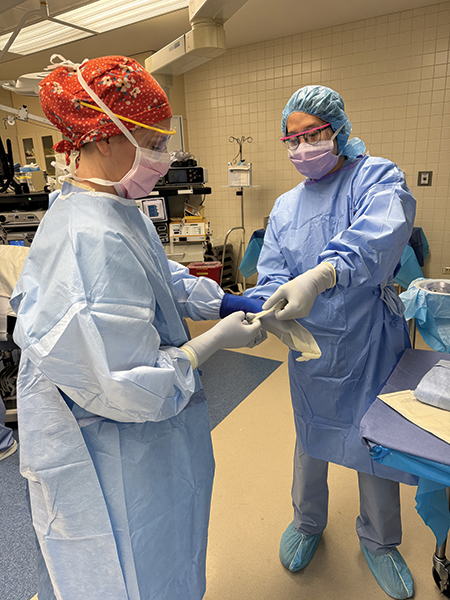
Nguyen and fellow surgical nurse Kelly Le, RN, have worked together for about three years. “I handle the sterile instruments and supplies, and hand them to the surgeon,” said Nguyen, who is the scrub nurse today. As the RN circulator, Le focuses on equipment, charting and patient comfort.
Nguyen puts on a mask, gown and gloves, and spreads blue covers on metal tables to create the sterile field. For 15 minutes he unloads supplies. Meanwhile, Le checks all the machines and safety monitors in the room. She powers up a microscopic camera that will be used during surgery to see inside Jayden’s shoulder. Later, she’ll activate a device to quickly cauterize blood vessels.
Just before 7:30 a.m., Le leaves to meet Jayden in pre-op while Nguyen carefully arranges instruments in precise order.
Nguyen meticulously counts out the number of blades and sutures. The count will be repeated before the incision is closed and again after surgery ends to ensure nothing is missing.
At 8 a.m., Jayden is wheeled into the OR. A scanner beeps as the anesthesiologist confirms his identity using his wristband. The room quiets for an anesthesia “timeout,” a final verbal safety check before sedation begins.
“Right side is the correct side,” Dr. Mojtahed says. Le confirms the information in the chart, and setup continues.
Pediatric orthopedic surgeon Kelsey Davidson, M.D., arrives in blue scrubs and a bright red scrub cap. At a nearby computer, she reviews Jayden’s chart, X-rays and scans before joining Nguyen to review the sterile instruments placed on the tables.
“Do we have the split drapes?” she asks.
By 8:30 a.m., the surgical team makes final preparations, moving lights and monitors. The team spends nearly half an hour cleaning and preparing the patient’s shoulder and arm before surgery begins. Le checks Jayden’s legs to ensure his position is correct, he’s comfortable and nothing is pressing into his skin.
The room goes quiet for a final “time-out.” Dr. Davidson has spent an hour ensuring that all tools are on hand and that Jayden is cleaned and safely positioned on the operating table.
“This extra level of attention from the surgeon is unique to Shriners Children’s,” says Poelsterl. Final safety checks are confirmed, and Jayden’s procedure begins.
Several hours later, Dr. Mojtahed says, “You’re all done, Jayden,” as the teen begins to wake and is taken to recovery, his shoulder in a large white bandage and black sling.
Nearly five hours after they began, Le and Nguyen are back in a quiet operating room, loading used tools and trays onto carts so they can be sent for sterilization.
“Everything went well throughout the case,” Nguyen says calmly.
— ANGELA CAREY, RN, director of Surgical Services
It’s the end of a long morning of careful, coordinated work — the kind of behind-the-scenes effort patients and families rarely see but that the OR team says is essential to delivering safe, exceptional surgical care.
“It’s a typical day in the OR,” says Angela Carey, RN, MSN, MBA, CNOR, director of surgical services. “We perform all of these safety checks for each case to make sure every patient receives the best care possible.”
What to Know About Anesthesia
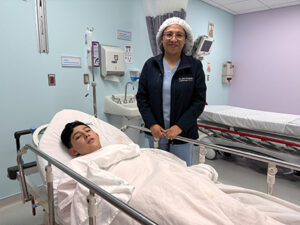
For many families, the hardest moment of surgery comes when their child disappears behind the operating room doors. What many parents may not realize is that the anesthesia team has been preparing for that moment long before the procedure begins.
According to Jannet Ortiz, M.D., pediatric anesthesiologist at Shriners Children’s México, care starts with a pre-anesthetic evaluation. During this visit, physicians assess the child’s overall health and identify anything that could affect the procedure.
“Our goal is to understand the patient as a whole and ensure they’re ready for surgery, while also answering parents’ questions,” she said.
On the day of surgery, patients are prepared in their rooms and accompanied by their parents to the entrance of the operating room, where they may receive medication to help them feel more relaxed.
Once inside, the anesthesiologist confirms that all equipment and medications are appropriate for the patient’s age and condition. Anesthesia is then administered, most commonly through inhaled medication.
Fabiola Torres, M.D., also a pediatric anesthesiologist at Shriners Children’s México, explained that during surgery, the anesthesia team continuously monitors the child’s condition while the surgeon focuses on the procedure itself.
“We’re there to protect the patient’s life throughout the procedure,” said Dr. Torres.
Did you know?
- Preparation starts early. Anesthesiologists review medical history, previous procedures, allergies, nutrition and potential risks while going over relevant factors with other specialists.
- Reducing anxiety matters. Children may receive medication to help them feel calm. Many enter the operating room relaxed or asleep.
- Constant monitoring. Throughout surgery, anesthesiologists track heart rate, breathing, blood pressure, oxygen levels and pain.
- Care continues after surgery. Recovery includes close monitoring for pain, nausea and other concerns before children reunite with their families.


